
Return of the Waltz!
by Anne Calder | Banner Photo by Liz Chastney
Editor’s Note: There is something quietly powerful about a waltz in ice dance. Not the sweeping, anonymous ballroom sway of a generic 3/4 melody—but the kind with edges. The kind with history.
For the 2026–27 season, the ISU’s Ice Dance Technical Committee has proposed that steps from two of the discipline’s most intricate pattern dances—the Golden Waltz (for senior) and the Westminster Waltz (for junior) —for inclusion in the Rhythm Dance. And in doing so, the ISU has not simply selected steps. It has selected lineage. These are not entry-level waltzes (there is a reason that the Westminster was unaffectionately named ‘the Westmonster’). These are dances that separate good teams from great ones. They are dances that expose posture, timing, ice coverage, and the ability to sustain uninterrupted flow across demanding sequences.
In Anne’s article below, she shares some of the history behind and information on these two pattern dances.
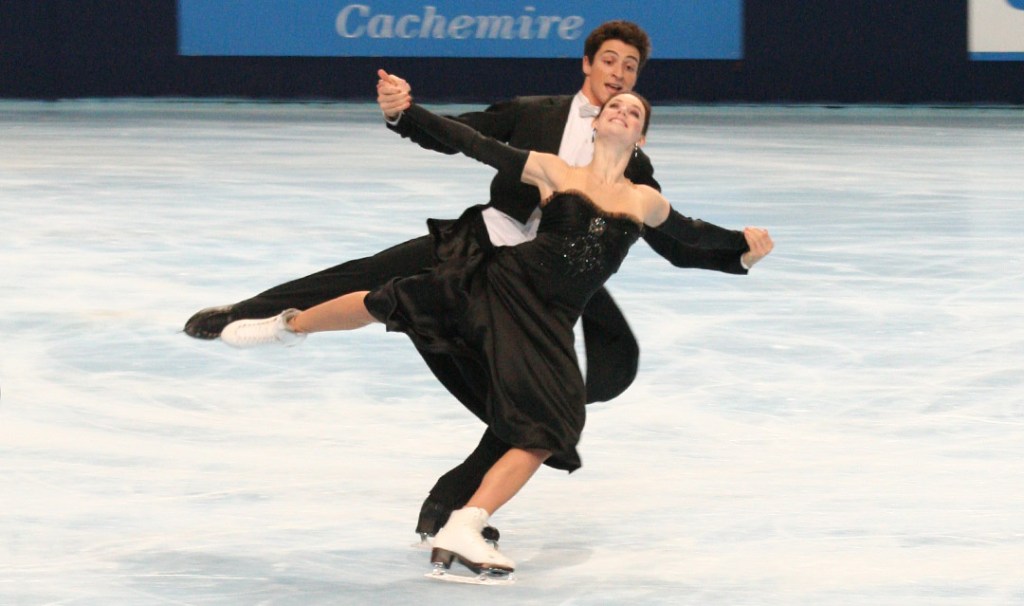
Tessa Virtue & Scott Moir skate the Golden Waltz at 2009 Trophee Eric Bompard Grand Prix event. Photo by Susanne Kempf.
History
The first unofficial international senior ice dance competition took place as a special event at the 1950 London and 1951 Milan World Figure Skating Championships.
Ice Dance made its historic inaugural World Ice Dance Championships debut in 1952 at the Palais des Sports in Paris, FRA. Four Compulsory dances and a five-minute Free Dance were competed. The CDs were drawn from four groups of dances: Rocker Foxtrot (easy), Westminster Waltz (waltz), Quickstep (fast) and Argentine Tango (slow).
In 1967, the Original Set Pattern (OSP) was added to the ice dance competitions, replacing one of the compulsory dances. It allowed teams to choose their own music and choreography to an ISU assigned specific rhythm and music type that changed yearly.
In 1990, the Original Set Pattern (OSP) name was shortened and renamed the Original Dance. In addition to the name change, the OD no longer required the dance be repeated exactly the same way around the rink and became more artistic and creative.
Following the 2010 Winter Olympics, the ISU merged the Compulsory and Original Dances into a single Short Dance. At this time, ISU introduced Key Points (3) to evaluate the precise execution of the pattern. They were:
(Y) yes completed, (N) not completed and (T) Timing error. The key points were increased to four in the 2014-2015 season to align with the four levels of difficulty.
Another name change occurred in 2018 when the title Short Dance became a themed Rhythm Dance that better reflected the focal point of where specific rhythms were competed.
Seasons 2022-2026 the seniors no longer competed a full set pattern dance. It was replaced with a Pattern Type Step (StyleD) (PSt) – a partial step sequence with difficult turns. Technical Panel’s Level-of-Difficulty system (Levels 1-4) combined with judges’ Grade of Execution (GOE -5 to +5) replaced the Key Points.
The Juniors have continued competing the pattern dance through 2025-2026. Key points have been used to evaluate the Dance.
Season 2026-2027
The Ice Dance Technical Committee has proposed that the theme and music for junior and senior rhythm dances for the 2026/27 season is Rhythm and Waltz.
Any style of waltz is permitted, from traditional forms to modern interpretations. At least one (1) additional rhythm must be included to support the chosen concept or theme.
The Pattern Dance Element is proposed as follows:
Junior: Westminster Waltz – One (1) sequence (54 three-beat measures per minute; 162 beats per minute, skated in 3/4 time)
Senior: Golden Waltz – A section of the pattern dance starting from step 34 through step 20. (62 three-beat measures per minute; 186 beats per minute, stated in 3/4 time)
Tanith Belbin & Benjamin Agosto skate the Golden Waltz at 2009 Cup of China Grand Prix event. Photo by Liz Chastney.
Part I: Golden Waltz
The Golden Waltz is a highly technical, demanding, and elegant ice dance.characterized by long, flowing edges, intricate, fast, and complex steps, and deep, lyrical, and romantic movements. The dance incorporates a wide range of movements, including various types of waltz steps, three-turns, twizzles, and other maneuvers.
It features the “shoot-the-duck” and the “spread eagle” as hallmark elements, which are highly athletic and unusual for traditional pattern dances.
At the 1987 international figure skating Prize of Moscow News (Moscow Cup) ice dance competition, the gold medalists were legendary Soviet Champions Marina Klimova & Sergei Ponomarenko, coached by Natalia Dubova. Their OSP Viennese Waltz is heralded as the genesis of the Golden Waltz.
The Golden Waltz made its debut in the 1996-1997 season, which also included Rhumba, Yankee Polka and Argentine Tango. Teams had to prepare four dances and be ready for a random pick. Only two were danced at the premier events.
At the 1997 European Championships in Paris, France the Golden Waltz made its official international debut as one of the two compulsory dances. The second dance was the Yankee Polka.
The top placements at the first Golden Waltz competition were:
Oksana Grishuk & Evgeny Platov (Russia)
Anjelika Krylova & Oleg Ovsyannikov (Russia)
Marina Anissina & Gwendal Peizerat (France)
Three months later, the Golden Waltz was competed again at the 1997 World Figure Skating Championships in Lausanne, Switzerland.
At the 2010 World Figure Skating Championships in Torino, Italy, the skating of the Golden Waltz marked the end of the Compulsory Dance era. Federica Faillla & Massimo Scali (ITA) were the last dancers to perform a CD in competition.
At the same event, Tessa Virtue & Scott Moir (CAN) earned the highest Golden Waltz CD score and went on to win the 2010 World Championships.
The following season – 2010-2011 introduced the new “Short Dance” format.
All senior ice dance teams were required to incorporate two sections of the Golden Waltz pattern into their routines. The 2010–11 season marked the elimination of the old compulsory dance and original dance format, replacing them with a single short dance that required specific patterned steps.
At the 2011 World Figure Skating Championships in Moscow, Russia, the Golden Waltz leader board was represented internationally.
Tessa Virtue & Scott Moir (Canada)
Meryl Davis & Charlie White (USA)
Nathalie Pechalat & Fabian Bourzat (France)
2010-2011 was the last season the Golden Waltz was named as a required dance until the most recent ISU announcement that a segment would be skated in the 2026-2027 Rhythm Dance.
Anastasia Olson & Jordan Cowan skate the Westminster Waltz at the 2009 Lake Placid Ice Dance Championships. Photo by Alexandra Sherman
Part II: Westminster Waltz
The Westminster Waltz is characterized by stately carriage and elegance of line. It should be skated with strong edges and a softly flowing knee action. An upright stance with-out breaking at the waist is essential to its stately character. Throughout the dance the many changes of position should appear to be effortless and in excellent unison.
Soft knee bends without bounce, free leg extensions which are strong but not flamboyant, matched free leg movements of couples, even pace and dignified expression all combine to enhance the refined character of this waltz.
During the 1930’s the National Skating Association of Great Britain, held competitions to encourage the creation of new, more challenging ice dances.
One of the newer dances invented by Eric van der Weyden and Eva Keats was the Westminster Waltz and first competed at the Westminster Ice Rink in London, England in 1938.
Following its debut, it was quickly integrated into national and international skill tests and early competitions.
World War II forced the cancellation of the World and European Championships from 1940 to 1946, and the Olympic Winter Games in 1940 and 1944.
In the U.S. new gold level tests were introduced in 1941. Two years later, the U.S. Figure Skating Association (USFSA) held the Nationals Championships at Madison Square Garden in New York City. It was historically elevated to a “Gold” event in formal recognition of the highest technical level in U.S. ice dance.
The Westminster Waltz was featured with three other dances competed by six couples competing in the final round of the inaugural event. The Westminster Waltz remains a “Gold” level test dance and continues to be used in various competitive rotations for Junior and Novice categories.
It became part of the International Skating Union’s (ISU) official list of compulsory dances in 1951 and was used in major international competitions, like the World Figure Skating Championships and Olympic Winter Games in 1968 and 1984.
During the 1959 ISU Congress, the description of Step 3 was officially altered to mandate a change of edge, ensuring the dance was skated exactly as its inventors originally designed.
In Sarajevo, Yugoslavia at the 1984 Winter Olympics, Jayne Torvill and Christopher Dean representing the United Kingdom, received perfect scores of 6 from three of the nine judges for their interpretation of the Westminster Waltz.
It was the third compulsory danced after the Paso Doble and Rhumba and the first given perfect scores for a compulsory dance in Olympic history.
Since the ISU merged the compulsory and original dances into the Short Dance (now Rhythm Dance) after the 2010 season, the Westminster Waltz has not been skated as a stand-alone segment.
However, it continues to remain in the rotation of Pattern Dance elements. The Westminster Waltz was first competed at the Novice level in 2015-16 and most recently at the 2025 U.S. Championships in Wichita, KS.