
Breaking Through: Kruk & Eisenhaber Make Their Mark at Junior Worlds
On Ice Photos by Yoriko Suzuki
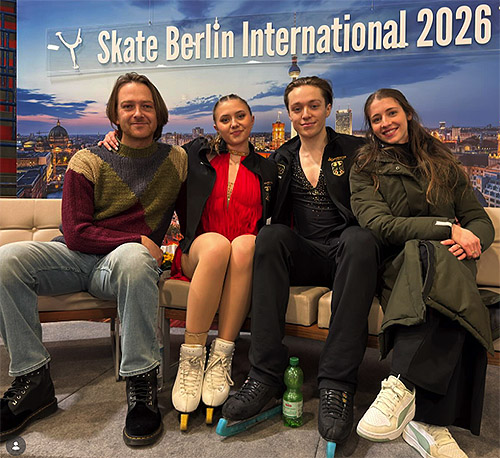
Germany’s Alexia Kruk & Jan Eisenhaber are emerging as a team to watch following a standout 2025–26 season that included strong Junior Grand Prix performances and an eighth-place finish at the World Junior Championships. IDC recently spoke to the duo about their partnership, accomplishments and more.
Tell us about your individual skating journeys, including any early special memories.
Alexia Kruk (AK): I started figure skating when I was 5 years old. I don’t quite remember how and why, as nobody in my family had anything to do with figure skating before. What a lot of people don’t know about me is that my parents come from Kazakhstan, and my dad used to play soccer there. They really wanted me to do some kind of sport as well before I went to school. I had no intention of skating. Apparently, I liked it so much that I just kept going and my love and passion to the sport continued to grow.
Jan Eisenhaber (JE): I first stepped onto the ice when I was two and a half years old. My mom was a skater until her mid-teenage years, and she started skating again as a hobby. She often took me to the rink with her. At first, I didn’t really enjoy skating myself — I mostly liked being at the rink and watching the other skaters, but I kept wanting to go back again and again. Over time, I started skating more and began to really enjoy it. I initially started in singles skating and entered a sports school in first grade.
What drew you to ice dance?
AK: I was always ok at jumping, but never the best. I was really good at interpretation, dancing, feeling the rhythm and the music, so that has always been my strength. I’m not shy at all when it comes to this. At first, I never really thought about doing ice dance.
JE: I started ice dance in third grade. My jumps never really worked well, but my former coach always said that I was very good with steps and turns and that my skating skills were stronger than those of many other skaters in this age. Because of that, she recommended that I try ice dance. For about half a year I trained both singles and ice dance, and then I finally decided to fully switch to ice dance. Having someone next to me on the ice and sharing the same passion and joy made it much more fun for me. Looking back, I feel that it was the best decision.
AK: I still remember my first competition in ice dance. I never liked competing in singles. It was always really stressful. In ice dance, it was completely different. I enjoyed every moment and you could tell that I was free. That’s when I realized I made the right decision and looking back wouldn’t have done it any differently. Of course, you have those big goals like going to the Olympics one day when you’re little, but I think most kids don’t realize what it really means and what kind of work you have to put in it. In reality, I would’ve never dreamed of traveling the whole world for this sport because it sounded so unreal. I don’t even think my family imagined this. We wanted to compete at the World Junior Championships for such a long time and when we finally made it, the feeling of skating there and the whole process before and during is really indescribable and I’m really thankful for this life.
How did the two of you first decide to team up, and what do you remember about your first tryout together?
AK: I was still in singles skating. Jan’s former ice dance coach in Berlin reached out to me to try out for ice dance, so I gave it a try. Both of us don’t remember a lot from our first tryout actually which is kind of funny. We were pretty young still. I think I was 11 and Jan was 13.
JE: I was skating for one year alone and I had some tryouts because I was looking for a partner, but none of the tryouts really worked out. I remember that my former coach suggested to do the tryout with Alexia because she was really good in performing on the ice. I don’t really have another memory of the tryout. It just worked well.
AK: The only thing I remember is that I really didn’t want to skate with a boy. It was the age where I just didn’t want to touch boys or want to look at boys, so the first tryout I kind of felt like this. I kept on trying and got used to it pretty quickly. Jan and I became good friends. A few days after, it was decided that we’re going to skate together. I was really nervous and was scared of doing something wrong because he already had some experience and I just wanted to be good enough. I thought of him as a really good skater already.
When did you start to feel like the partnership truly “clicked”?
AK: We’ve always had a pretty good partnership and as you get older it also gets closer and you develop a friendship. In Advanced Novice, I think we were about 14 and 16, we already had the base of a partnership and then as you grow older you also start to develop and it starts to click. It’s like a transition that you can’t even really feel. Also, especially last season after the Junior Grand Prix, we grew even closer and started working better together and truly understanding the value of the partnership. I think that is why this season has also been so successful for us.
What do you like most about skating with your partner?
AK: For me, it’s pretty simple, you never feel alone. You always have somebody that you know has your back. It’s just a special feeling that skating with a partner gives you. Also, Jan is very caring and I can trust him with everything. It is just nice to know that you always have somebody with you.
JE: I like to skate with somebody next to me because then we can push each other. Especially because she is an amazing dancer, she can help me a lot with some movements even more and get the best moves out of me.
Tell us about your coaches and choreographers.
AK: Stefano Caruso and Robynne Tweedale are our two main coaches. We are very close. it’s like our little skating family. They’re both pretty different. Stefano’s Italian you can really feel it on the ice. Also, he’s a technical specialist so he pays a lot of attention on the technical aspects, the turns, the key points, the levels. Robynne is also our choreographer so we do a lot of arm and body movements with her. She’s there for the details and to really clean it up.
JE: Most of this year’s choreo was made by Robynne. In the rhythm dance, she had some help from Stefano Ati, a dancer and a guest coach.
AK: We worked a lot of arm movements with him. He did our beginning, our stop part and he also choreographed our ending.
JE: Stefano Ati was there for all the details in the rhythm dance. In the free dance, Robynne did the choreo. She had some help from Matthew Gates. He did some tricks and parts of the beginning.
AK: Some transitions we also did with Matthew. Of course throughout the season we switch up some things. We develop the choreography, but mainly we do it with Robynne. Throughout the year different guest coaches also come to Berlin. We work a lot with Catherine Papadakis, the mother of Gabriella. Jimmy Young is also part of our team. He came a lot this year, especially. Before the Junior Worlds, we trained with Olga Rabinina who came to Berlin right before the Junior Worlds.
JE: Stefano (Caruso) is very connected and he tries to give us the opportunity to work with all the different coaches because everybody has a different view and ideas about skating and dancing. We try everything and in the end we can choose what works the best for us and we like the most. We have plenty of opportunities to choose the best for our performances.
AK: To me, it’s also interesting to see the different styles each coach has. They also have different personalities and how they handle situations on the ice and off the ice too. We really like working with different coaches throughout the season.
Where are you currently training, and what does a typical training day look like for you?
JE: We are currently training in Berlin. We don’t really have a typical day because every day is slightly different because of Alexia’s school. We have two sessions each day – morning and evening, so it’s switching between practice and school for Alexia. We also workout three four times a week. We’re on the ice every day for about four hours at least.
AK: Because I’m still in school, we have to find the time to make it work together. Jan is in university, that’s why it’s a bit easier. He has more freedom, so he can adapt the times when he wants to practice and when he wants to study. For me, the times are set for school. That’s why it’s more up to me how we can train. Additionally, in the off season, we do ballet, dancing and stretching, so it really also depends on what time of the year it is.
What aspects of ice dance did you focus on the most this season—technical elements, performance quality, or something else?
AK: We wanted to improve our basic skating, so we worked a lot on basic skating quality to show this in programs to get higher components. Additionally, we worked on upper body movements and unison and connection this season.
What off-ice preparation has been particularly helpful for your development as a team?
JE: Stefano (Caruso) is a big fan of the dance Lindy Hop. We had some sessions of Lindy Hopp especially in the off-season. It’s a dance where there’s no steps that are set. You just have one leader and one follower, so you can practice leading and also following. The leader can decide which steps he likes to do and you just try to follow and feel the music together.
Tell us about your programs this season. What inspired your music choices and overall themes?
AK: For the rhythm dance, we used to do a latin free dance back in advanced novice. It worked very well and suited us and also was really fun. Robynne came up with the idea to do a latin rhythm dance this season. When we heard that it was the 90s theme, we instantly thought of Ricky Martin because he’s really famous and his songs are really really cool, so it was pretty easy with the rhythm dance music. We decided on “Maria” and “La Copa de la Vida.”
We chose the music quite fast, so we had it pretty early in the season. We wanted to do a slower part for the Rhumba/Quick Step because we thought it’s going to be a slower rhythm and also to switch up the rhythm a little bit. We chose “Maria Maria” from Santana because it also matched the latin theme and was more of a Rhumba feeling. Then they decided to change the timing for the pattern dance so it’s on faster music, but we didn’t want to give up the Santana part. That’s why we decided to make it a little bit shorter, but still keep it for the transition and lift because we really like this music.
JE: In the free dance we try to do a different style of music every year. We had already skated an indian program, tango program and last year we had the music from the movie Billy Elliot. This year, our goal was to show elegance on the ice. That’s why we chose a more lyrical melancholic one. We wanted to show our lines and elegance and good quality basic skating.
AK: Our coaches came up with Cold Play and we liked the idea. The first part was also set pretty early in the season. We had some trouble with music for the second part, but then “Fix You” was a really good choice because it had a ‘lifting up’ moment towards the end of the free dance.
How involved are you in the choreography process?
JE: We get ideas from our choreographers and then we try the steps and decide how we feel with them and keep or change them. We are always open to adjusting them the whole season and to add more details. Also, if we have a cool idea or we find something special, we show them and talk about putting it in the choreo somewhere.
Did you set any goals for this season and if so, what were they?
JE: Our goals were to start the season earlier to be better prepared for the Junior Grand Prix. That’s why we did the Lake Placid International. We wanted to leave a good impression on the Junior Grand Prix series as last season it was not so great for us. We also wanted to collect some world ranking points. Another goal was to become German national junior champions this year. Our last big goal was to compete at Junior Worlds and to make the top 10 there.
What have been some of the biggest lessons you’ve learned from competing internationally?
AK: As we are a couple that also experienced a lot of downs with some ups, the biggest lesson is that you really have to also take another point of view on it. You can’t let everything come so deeply to you because it really kills you from the inside. You just have to take the experience and learn from it. That’s what truly helped us to come to the point where we were able to show off what we can do, especially this season in the Junior Grand Prix and also Junior Worlds. Also, it’s not in your hands how the score is going to come out, so you really have to just show your best and learn to be happy even though it’s not always perfect.
Is there a competition performance that stands out as a breakthrough moment for you as a team (so far)?
JE: We both quite quickly thought of the Junior Grand Prix in Abu Dhabi this season because it just felt really good to perform there. We had a quite good performance and we got good points, so overall it was a nice experience there. We also came very close to the podium and that proved us that we are on the right path in training and in general as a couple.
AK: Coming so close to the podium was also some kind of extra motivation that okay we can actually make it, so that’s kind of also our goal next season. It also showed us that despite mistakes the work that we did on quality skating paid off because we got actually quite good points and placed pretty high.
You finished eighth at the 2026 World Junior Championships, did you have a goal heading into this event?
AK: Our goal was to make the top 10 and we got eighth, which was honestly pretty unexpected. We had two solid performances. Even though there were small mistakes, I think we’re very proud and happy. I think we’ve never been this nervous before in any competition, so you could really feel the nerves and handling the nerves is something that’s not talked about a lot. We’re proud that we earned two spots for Germany and will hopefully be competing next year in Sofia as well.
What do you take from your performances there to help push you for next season?
JE: We take from them that we don’t think too much before the skate because there will never be a perfect performance. We just have to enjoy every moment on the ice as we step on it and give everything we have even with a lot of nerves. We can go into the competitions next season and be a bit more relaxed, so that we can enjoy it even more.
If you could have a lesson with any ice dancer past/present, who would it be? Why?
JE: It would be Guillaume (Cizeron) because of his amazing skating skills so i would like to a lesson with him.
AK: I instantly thought about Charlie White. To me, he’s one of the greatest skaters of all time. All the crazy stuff that he did with Meryl i just would really love him to teach us something or give us some tricks and insights.
What’s one word that best describes your partnership?
AK: If we had to describe our partnership in one word it would be continuity because we just have been skating together for such a long time. Despite everything we’ve been through with the ups and downs, the bad times, the good times, all the experiences, we’re still here together. We’re excited to see what will happen in the future. We’re a strong couple that sticks together no matter what and we’ve proven that.
Follow Alexia Kruk & Jan Eisenhaber on their individual and team Instagram accounts.